
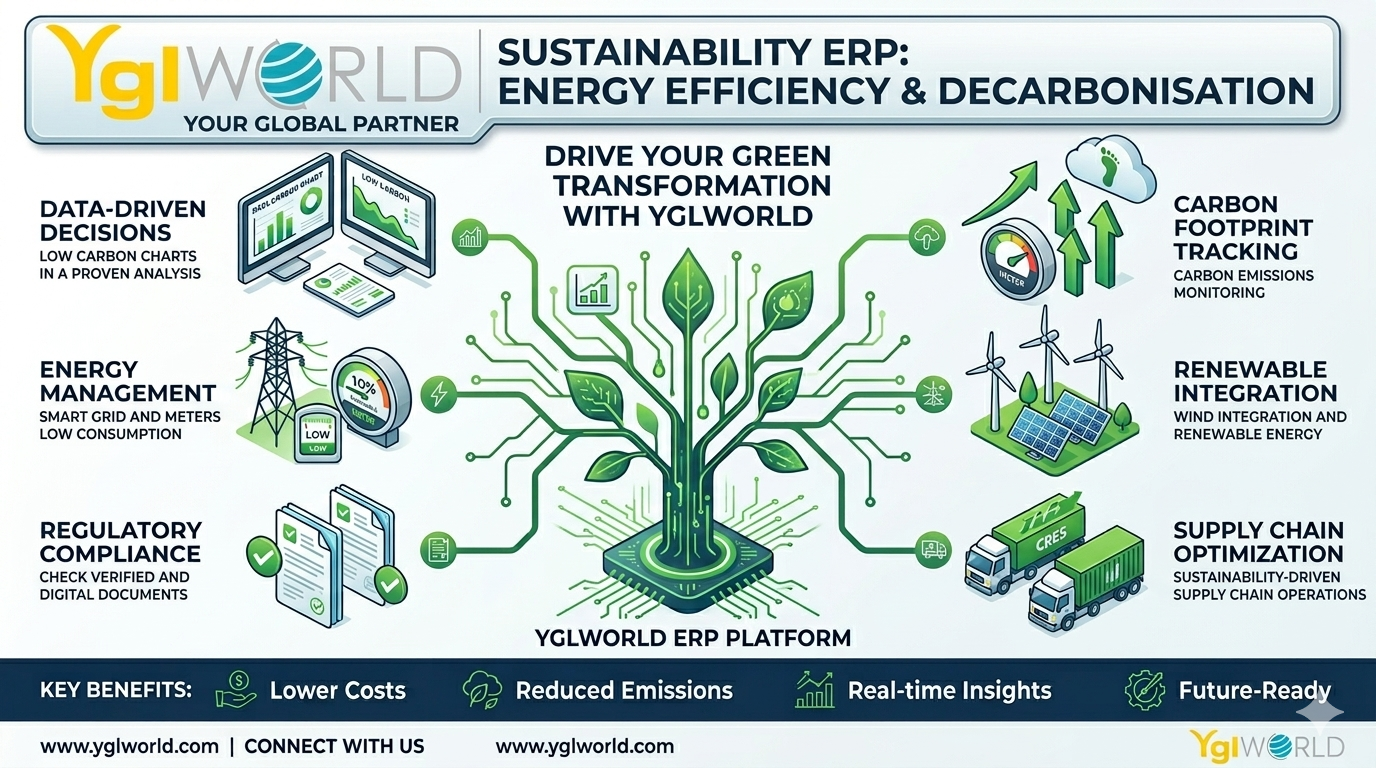
Introduction to Sustainability ERP
Sustainability ERP is helping businesses improve energy efficiency, reduce carbon emission, and automate sustainability processes. Today, companies face increasing pressure to meet ESG requirements while maintaining profitability.
As expectations rise, businesses need smarter systems to manage sustainability efforts. A modern ERP platform like YGL ERP provides the tools to track performance, optimize resources, and support long-term environmental goals.
Why Businesses Need Smarter Sustainability Systems
Growing ESG Requirements
Regulations and stakeholder expectations are evolving quickly. Companies must now measure and report their environmental impact with accuracy.
Because of this, relying on spreadsheets or manual tracking is no longer practical. An integrated ERP system ensures all sustainability data is centralized and reliable.
Rising Energy Costs
Energy prices continue to increase across industries. Therefore, improving efficiency has become a top priority.
With the right system in place, organizations can monitor usage, reduce waste, and lower operational costs.
Driving Energy Efficiency with YGL ERP
Real-Time Energy Visibility
YGL ERP allows businesses to monitor energy consumption across operations. This includes machinery, warehouses, and office facilities.
With real-time insights, decision-makers can identify inefficiencies quickly. As a result, corrective actions can be taken without delay.
Data-Driven Improvements
Advanced analytics reveal patterns in energy usage. These insights help companies optimize workflows and reduce unnecessary consumption.
In addition, predictive tools enable better planning. This prevents overuse and improves overall efficiency.
Automation for Energy Control
Automation enhances sustainability efforts. YGL ERP integrates with IoT devices to manage systems such as lighting and equipment.
Consequently, energy is only used when required. This reduces waste and improves operational performance.
Managing Carbon Emission Effectively
Accurate Emission Tracking
Tracking carbon emission manually can be complex and time-consuming. However, an ERP-based system simplifies the process by capturing data automatically.
This ensures accuracy and supports compliance with ESG standards.
Comprehensive Emission Coverage
Businesses can track:
- Direct operational emissions
- Indirect emissions from electricity
- Supply chain-related emissions
Having a complete view allows better decision-making and planning.
Actionable Reduction Strategies
Once emissions are measured, improvement becomes easier. The system highlights areas with high environmental impact.
For example, companies can optimize logistics routes or adopt cleaner energy sources. These actions contribute to meaningful reductions.
Decarbonisation Through Automation
Streamlining Sustainability Processes
Manual processes often lead to errors and delays. Automation simplifies data collection, reporting, and compliance tasks.
As a result, teams can focus on strategy instead of routine work.
Integration Across Operations
Sustainability should not be isolated. YGL ERP connects sustainability goals with daily operations.
For instance:
- Procurement teams can select eco-friendly suppliers
- Production teams can reduce energy usage
- Logistics teams can plan efficient routes
This creates a unified approach to sustainability.
Continuous Optimization with AI
Artificial intelligence enhances system capabilities. It analyzes data and recommends improvements over time.
Therefore, businesses can continuously improve their sustainability performance.
Key Benefits for Businesses
Operational Efficiency
Processes become more streamlined and effective. This improves productivity across departments.
Better ESG Reporting
Accurate data supports transparent reporting. This builds trust with stakeholders and regulators.
Cost Savings
Reduced energy usage and waste lead to significant financial savings.
Stronger Market Position
Sustainable practices attract investors and customers. This gives businesses a competitive advantage.
Industry Use Cases
Manufacturing
Manufacturers can reduce energy consumption and improve production efficiency.
Warehouse & Logistics
Smart systems optimize inventory movement and reduce fuel usage.
Commercial Buildings
Organizations can manage energy usage across lighting and cooling systems effectively.
Internal Linking Suggestions
To improve SEO and navigation, link this page to:
- YGL Smart Warehouse Solutions
- ESG Middleware Solutions
- ERP for Manufacturing
- Energy Management Systems
- Digital Transformation Services
These links enhance user experience and strengthen search performance.
Best Practices for Implementation
Start with Reliable Data
Ensure all relevant systems are connected for accurate data collection.
Define Clear Goals
Set measurable targets for energy reduction and emission control.
Train Your Team
Employees should understand how to use the system effectively.
Monitor Progress Regularly
Continuous monitoring helps identify new opportunities for improvement.
The Future of Sustainable ERP Systems
Technology continues to evolve rapidly. With advancements in AI and IoT, ERP systems will become even more intelligent.
In the future, automation will play a bigger role in achieving sustainability targets. Businesses that adopt these solutions early will gain significant advantages.
Conclusion: Build a Greener Business with YGL ERP
Sustainability ERP plays a key role in helping businesses improve efficiency, reduce carbon emission, and achieve ESG goals.
YGL ERP provides the tools needed to automate processes, gain insights, and drive continuous improvement. By adopting this solution, companies can reduce costs while contributing to a more sustainable future.
Now is the right time to take action and transform your operations with smarter, greener technology.
We look forward to hearing from you. Contact us today so that we can help you with our YGL NERVO which is strategy Industry 4.0 ready implementation needs heading towards Industry 4.0 in smart warehouse and smart manufacturing.
YglWorld PG (HQ)
35, SCOTLAND ROAD
10450 Penang Island
YglWorld KL
Suite 9-10
Wisma UOA II,
Jalan Pinang 50450
Kuala Lumpur