
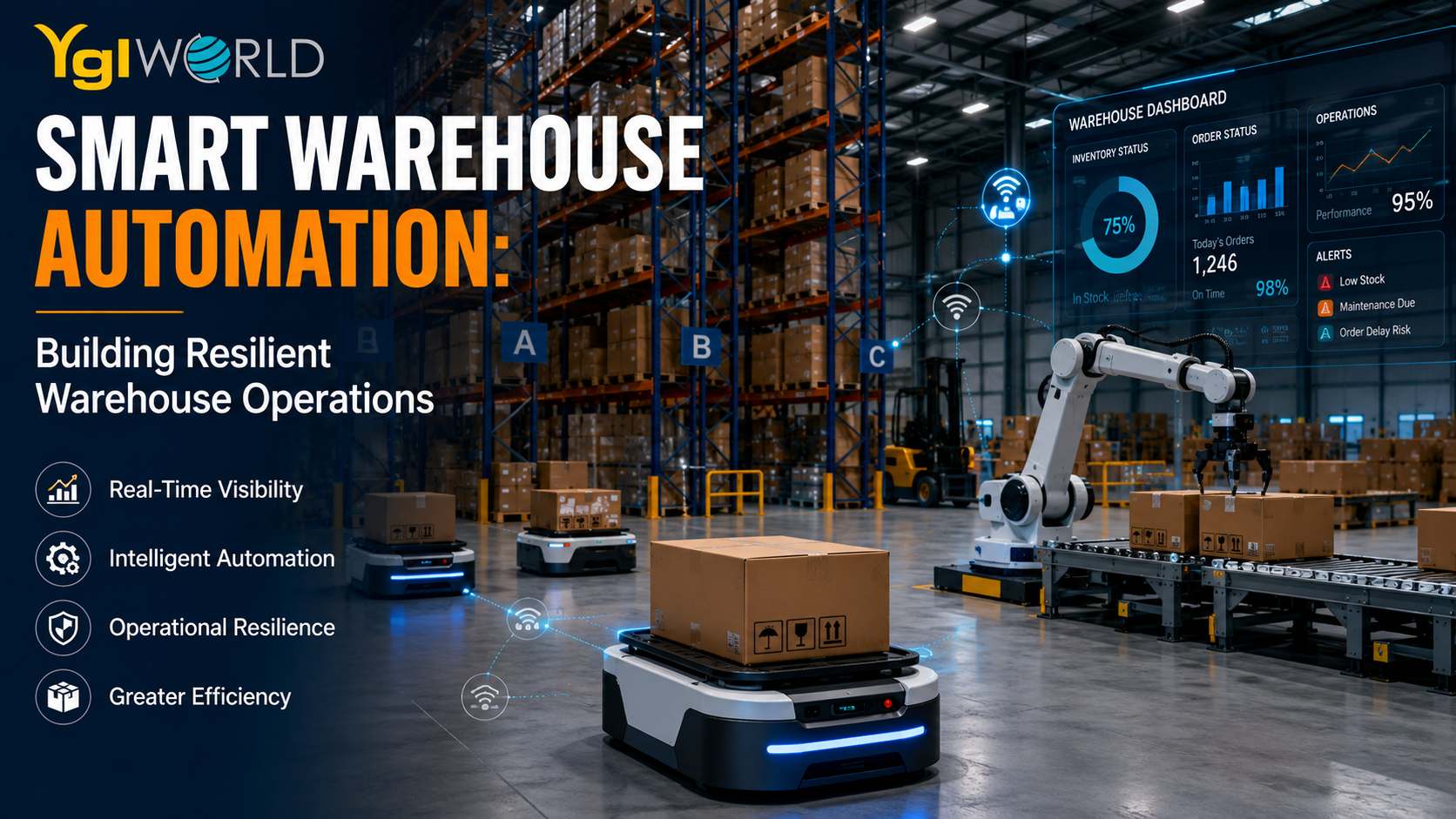
Modern warehouses are evolving rapidly. Rising customer expectations, labour shortages, supply chain disruptions, and increasing operational costs are pushing businesses to rethink traditional warehouse practices. As a result, many companies are adopting Smart Warehouse Automation to create faster, more accurate, and more resilient operations.
Today’s warehouse is no longer just a storage space. Instead, it has become a connected operational hub powered by software, automation, and real-time data. Intelligent systems now help businesses improve visibility, reduce manual work, and make faster decisions. Furthermore, smart technologies support operational continuity even during unexpected disruptions.
Companies that invest in smarter warehouse strategies are better prepared for future growth. At the same time, they can improve customer satisfaction, strengthen inventory accuracy, and enhance workforce productivity.
Why Smart Warehouse Automation Matters
Warehouse operations have become more complex than ever before. Customer demand changes quickly, while delivery expectations continue to rise. Therefore, businesses need systems that can adapt efficiently and consistently.
Traditional warehouse methods often rely heavily on manual processes. Unfortunately, manual workflows may create delays, inventory errors, and operational inefficiencies. In contrast, automated systems improve process control and provide real-time operational insights.
Smart warehouse automation helps organisations:
- Improve inventory accuracy
- Reduce operational downtime
- Enhance order fulfilment speed
- Minimise human errors
- Strengthen supply chain visibility
- Support business continuity planning
Moreover, automation allows warehouse teams to focus on higher-value activities instead of repetitive manual tasks.
How Intelligent Systems Improve Operational Visibility
Operational visibility is one of the most important advantages of a connected warehouse. Businesses need accurate information to make timely decisions. Without real-time visibility, warehouse managers may struggle to monitor inventory levels, shipment status, and operational performance.
Real-Time Inventory Tracking
Smart warehouse systems use barcode scanning, RFID technology, IoT sensors, and integrated software to track inventory movement continuously. Consequently, warehouse operators can identify stock locations instantly and reduce misplaced inventory.
Real-time tracking also helps companies avoid stock shortages and overstock situations. Additionally, businesses can improve demand forecasting by analysing historical inventory patterns.
Data-Driven Operational Monitoring
Modern warehouse dashboards provide live operational updates. Managers can monitor picking rates, delivery schedules, storage utilisation, and employee productivity from a centralised platform.
As a result, decision-makers can respond quickly when operational bottlenecks appear. Faster visibility often leads to faster corrective action and improved warehouse efficiency.
The Role of Software and Data in Connected Warehouses
Software plays a critical role in enabling smart warehouse automation. Without proper system integration, automation equipment alone cannot deliver full operational value.
Warehouse Management Systems (WMS), Enterprise Resource Planning (ERP) platforms, and analytics tools work together to create a connected warehouse ecosystem.
Warehouse Management Systems (WMS)
A Warehouse Management System helps businesses manage inventory, order fulfilment, stock movement, and warehouse workflows more efficiently.
For example, a WMS can automatically assign picking tasks, optimise storage locations, and generate inventory reports in real time. Consequently, warehouse operations become more organised and scalable.
ERP Integration for Better Coordination
ERP integration strengthens coordination between departments such as procurement, finance, logistics, and sales. When warehouse data connects directly with ERP systems, businesses gain end-to-end operational visibility.
Furthermore, integrated platforms reduce duplicate data entry and improve reporting accuracy. This connectivity helps companies make more informed business decisions.
Predictive Analytics and Reporting
Data analytics tools allow businesses to analyse warehouse trends and predict future operational needs. Predictive insights support smarter inventory planning, maintenance scheduling, and workforce allocation.
Because of this, businesses can reduce operational risks while improving resource management.
Why Smart Automation Supports Efficiency and Resilience
Efficiency remains a key priority for warehouse operators. However, resilience has become equally important in today’s uncertain business environment.
Smart warehouse automation supports both objectives simultaneously.
Reducing Operational Disruptions
Automated systems help warehouses maintain operational continuity during labour shortages or unexpected disruptions. Automated workflows also reduce dependency on manual processes.
For instance, automated picking systems can continue operating with minimal human intervention. Therefore, businesses can maintain productivity even during staffing challenges.
Improving Accuracy and Speed
Automation technologies improve operational consistency by reducing manual errors. Picking, packing, and inventory counting become faster and more accurate.
As a result, customer satisfaction improves because orders are processed correctly and delivered on time.
Enhancing Workforce Productivity
Smart automation does not replace employees entirely. Instead, it supports workers by simplifying repetitive tasks and reducing physical strain.
Employees can then focus on supervisory, analytical, and customer-focused activities that create greater business value.
Practical Examples of Modern Automation Approaches
Many warehouses are already adopting practical automation solutions to improve performance and scalability.
Automated Storage and Retrieval Systems (ASRS)
ASRS technology automatically stores and retrieves inventory using computer-controlled systems. These solutions maximise warehouse space while improving picking accuracy.
Additionally, ASRS systems reduce travel time inside the warehouse, which helps improve productivity.
Autonomous Mobile Robots (AMR)
Autonomous Mobile Robots move goods throughout the warehouse without requiring fixed infrastructure. These robots support picking, transportation, and inventory movement tasks.
Because AMRs are flexible and scalable, businesses can expand automation gradually based on operational needs.
Smart Conveyor and Sorting Systems
Conveyor automation improves material handling efficiency. Intelligent sorting systems also accelerate order processing and shipment preparation.
Consequently, warehouses can handle larger order volumes while maintaining operational accuracy.
IoT Sensors and Smart Devices
IoT devices provide real-time monitoring of warehouse conditions, equipment performance, and inventory movement. Sensors can detect operational abnormalities early and trigger alerts automatically.
This proactive monitoring helps reduce downtime and improve operational reliability.
Key Considerations for Future Warehouse Planning
Warehouse transformation requires careful planning and long-term thinking. Businesses should evaluate operational goals before investing in automation technologies.
Scalability and Flexibility
Future-ready warehouses must support business growth. Therefore, companies should select systems that can scale alongside operational expansion.
Flexible automation solutions also help businesses adapt to changing customer demands and market conditions.
System Integration Capabilities
Successful automation depends heavily on system connectivity. Businesses should prioritise platforms that integrate smoothly with existing ERP, WMS, and supply chain systems.
Strong integration improves operational efficiency and supports accurate data sharing.
Workforce Readiness and Training
Technology adoption requires employee support and training. Warehouse teams need proper guidance to operate and manage automated systems effectively.
Training programs also help employees adapt confidently to digital transformation initiatives.
Cybersecurity and Data Protection
Connected warehouses rely heavily on digital systems and cloud-based platforms. Therefore, cybersecurity protection is increasingly important.
Businesses should implement strong access controls, backup procedures, and security monitoring to protect operational data and maintain system reliability.
Building a Smarter and More Resilient Warehouse Future
Smart warehouse automation is no longer a future concept. It has become an essential strategy for businesses seeking operational efficiency, resilience, and long-term competitiveness.
Connected systems, intelligent software, and real-time data are transforming how warehouses operate. At the same time, automation technologies help businesses improve accuracy, strengthen visibility, and reduce operational risks.
Companies that embrace digital warehouse transformation today will be better prepared for tomorrow’s challenges. More importantly, they will create agile operations that can adapt quickly in an increasingly dynamic supply chain environment.
As technology continues to evolve, smart warehouse automation will remain a critical foundation for building resilient, efficient, and future-ready warehouse operations.
We look forward to hearing from you. Contact us today so that we can help you with our YGL NERVO which is strategy Industry 4.0 ready implementation needs heading towards Industry 4.0 in smart warehouse and smart manufacturing.
YglWorld PG (HQ)
35, SCOTLAND ROAD
10450 Penang Island
YglWorld KL
Suite 9-10
Wisma UOA II,
Jalan Pinang 50450
Kuala Lumpur