
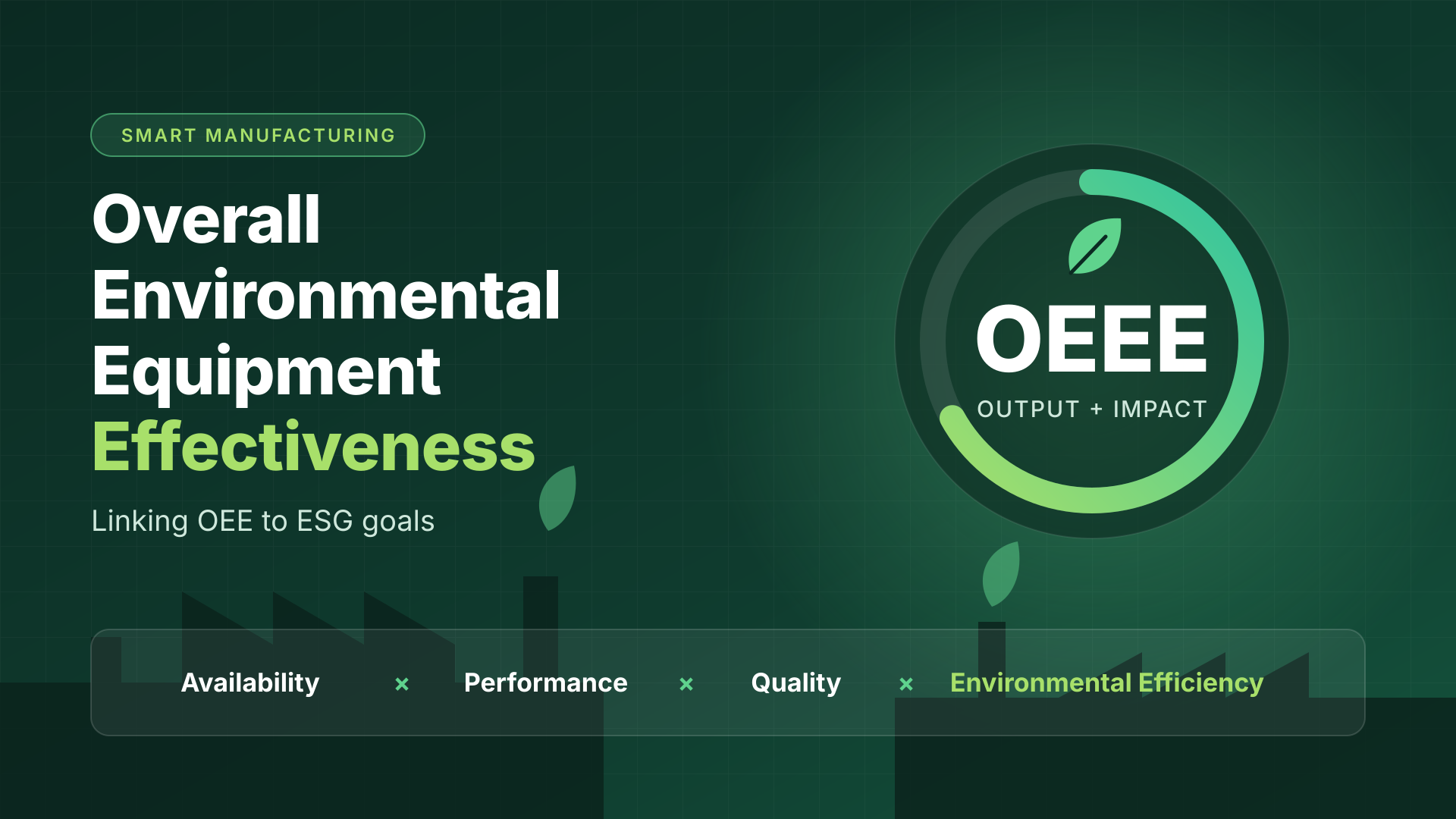
Overall Environmental Equipment Effectiveness (OEEE) is a factory metric that shows how well a machine turns time, energy and materials into good products. In simple terms, it adds an environmental lens to classic OEE. As a result, plant managers can see output and impact side by side. For manufacturers facing ESG reporting, that combined view is quickly becoming essential.
What Is Overall Environmental Equipment Effectiveness?
Most factories already track Overall Equipment Effectiveness. However, OEE only tells you how productive a machine is. It says nothing about the energy, water or raw material each part consumes. OEEE closes that gap by joining productivity and sustainability in one score.
A Quick Recap of OEE
OEE has three parts. Availability measures how long the machine actually runs against planned time. Next, Performance checks whether it runs at its ideal speed. Finally, Quality looks at the share of good parts versus total parts made. Multiply the three together, and you get the OEE score.
Adding the Environmental Factor
The environmental version keeps those three factors. On top of them, it adds a fourth factor based on environmental impact. This factor can track energy per unit, carbon emissions, water use or material waste. Researchers first proposed OEEE as a way to prove that lean and green manufacturing can share one common metric.
How to Calculate OEEE
There is more than one way to build the formula. Academic models often include the impact of the whole product life cycle. For daily use on the shop floor, though, a simpler approach works well:
OEEE = Availability × Performance × Quality × Environmental Efficiency
Here, Environmental Efficiency compares your target resource use with your actual use. For instance, you might divide target kWh per good unit by actual kWh per good unit. A result of 100% means the machine is using no more energy than planned.
A Simple Worked Example
Imagine an injection moulding machine with these results for one shift:
- Availability: 90%
- Performance: 95%
- Quality: 98%
Its OEE is 0.90 × 0.95 × 0.98, which equals 83.8%. That looks healthy at first glance. Now, suppose the target is 2.0 kWh per good part, but the machine actually uses 2.5 kWh. Environmental Efficiency is therefore 2.0 ÷ 2.5, or 80%.
Multiply 83.8% by 80%, and the environmental score drops to 67.0%. In other words, a machine that seemed efficient is quietly wasting energy. Without this metric, that loss would stay hidden.
OEE vs Overall Environmental Equipment Effectiveness
Both metrics share the same foundation. Still, they answer different questions. OEE asks, “How well are we using our machines?” By contrast, OEEE asks, “How well are we using our machines and our resources?”
That small change shifts how teams make decisions. For example, a faster cycle time may boost OEE. If it also pushes energy use sharply higher, the environmental score may fall. Seeing both numbers together helps managers choose changes that improve output without raising the carbon footprint. Ultimately, it turns sustainability from a yearly report into a daily production target.
Why OEEE Matters for Sustainability and ESG Goals
Investors, banks and buyers now ask hard questions about carbon and resource use. Meanwhile, stock exchanges and regulators keep raising disclosure standards. Environmental equipment effectiveness gives you machine-level proof to support your answers.
Lower Energy Use per Good Unit
Idle machines still draw power. Similarly, frequent restarts cause energy spikes. By tracking OEEE, you can spot these patterns and fix them. Better uptime and steady speeds usually mean fewer kWh for every good part.
Less Waste and Scrap
Every rejected part wastes material, energy and labour. Because Quality sits inside the formula, scrap pulls the score down twice. First, it lowers OEE. Second, it raises the energy used per good unit. This double effect makes waste reduction a clear priority.
Credible ESG Data
Sustainability reports need numbers that auditors can trust. Rather than relying on rough estimates, OEEE draws on real machine data. Consequently, your Scope 2 energy figures and waste data become easier to verify. This data also supports green financing and customer audits.
Common Challenges When Tracking Environmental Equipment Effectiveness
Getting started is not always easy. Many older machines have no energy meters. Data also tends to sit in separate systems, such as spreadsheets, maintenance logs and utility bills. In addition, teams may disagree on which environmental factor to use.
Setting fair targets is another hurdle. A target that is too loose hides waste. On the other hand, a target that is too strict makes every machine look poor. The best approach is to start with historical data and tighten targets over time.
How to Start Measuring OEEE in Your Factory
You do not need to change the whole plant at once. Instead, follow these practical steps:
- Pick a pilot line. Choose a machine group with high energy use or high scrap.
- Install smart meters. Add IoT sensors to capture power, run time and output in real time.
- Connect your systems. Link machine data to your MES and ERP so that production and energy records match.
- Choose one environmental factor. Energy per good unit is often the easiest place to begin.
- Review results weekly. Share OEEE dashboards with production, maintenance and sustainability teams.
- Scale up. Once the pilot shows results, roll the method out to other lines.
Digital tools make this far simpler. A manufacturing execution system can collect machine states automatically. Likewise, an ESG data platform can turn those readings into carbon figures for your sustainability statement.
Final Thoughts on Overall Environmental Equipment Effectiveness
OEE has guided factory improvement for decades. Yet today’s manufacturers must also prove they use resources wisely. Overall Environmental Equipment Effectiveness meets both needs in one practical number. It reveals hidden energy losses, highlights the true cost of scrap and gives ESG reports a solid base of real data.
Start small, measure honestly and improve step by step. Over time, each gain in OEEE becomes a gain in profit and sustainability at the same time.