
Introduction
Manufacturing companies today face increasing pressure to reduce operational costs, improve productivity, comply with Environmental, Social, and Governance (ESG) requirements, and achieve ambitious decarbonisation targets. Despite significant investments in digital technologies, many factories continue to operate with disconnected systems that limit visibility into energy consumption, material waste, carbon emissions, and overall operational efficiency.
Green Manufacturing Intelligence is emerging as the next evolution of smart manufacturing. Rather than simply collecting data, it enables manufacturers to transform information into actionable insights that drive cost savings, sustainability improvements, and operational excellence.
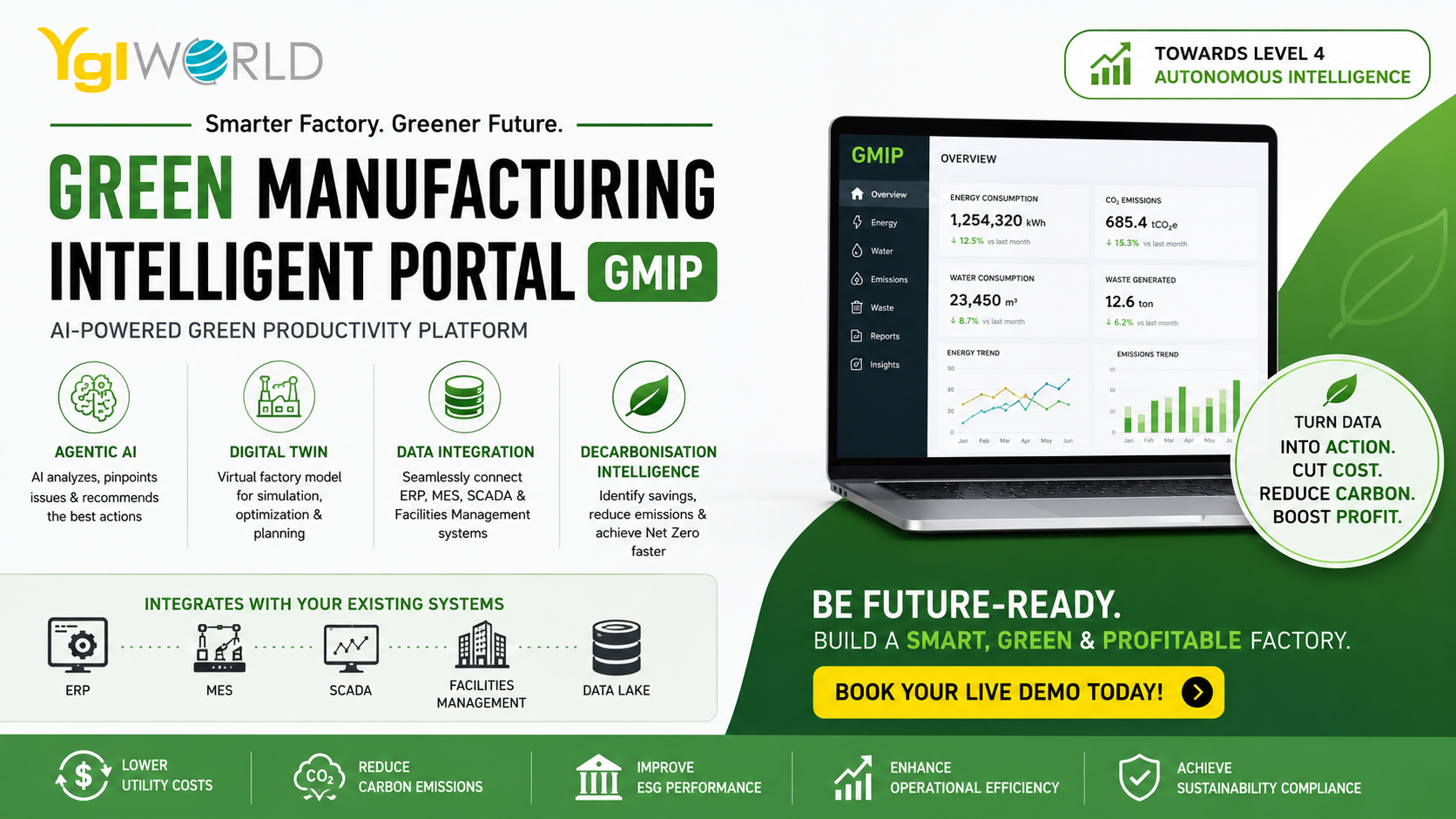
To address these challenges, YGL has developed the Green Manufacturing Intelligent Portal (GMIP), an advanced AI-powered Green Productivity platform designed to help manufacturers progress towards Level 4 Autonomous Intelligence. The platform integrates operational data, utility information, and ESG metrics into a centralized environment that delivers real-time monitoring, intelligent analysis, and autonomous decision support.
What Is Green Manufacturing Intelligence?
Green Manufacturing Intelligence refers to the use of artificial intelligence, digital twin technology, advanced analytics, and integrated operational data to improve manufacturing performance while reducing environmental impact.
Traditional ESG platforms primarily focus on collecting sustainability data and generating reports. However, modern manufacturers require more than reporting capabilities. They need intelligent systems capable of identifying inefficiencies, detecting anomalies, predicting future issues, and recommending corrective actions.
GMIP extends beyond conventional ESG software by transforming sustainability management into a continuous improvement process that directly supports profitability and competitiveness.
As a result, manufacturers gain deeper visibility into operations while accelerating their sustainability journey.
Challenges Facing Modern Manufacturers
Fragmented Legacy Systems Create Data Silos
Many manufacturers operate multiple systems, including Enterprise Resource Planning (ERP), Manufacturing Execution Systems (MES), Supervisory Control and Data Acquisition (SCADA), and Facilities Management platforms.
Although each system serves a valuable purpose, they often function independently. Consequently, management teams struggle to obtain a complete view of factory operations.
Without integration, decision-makers face challenges such as:
- Limited visibility into energy consumption
- Delayed reporting and analysis
- Manual data collection processes
- Inconsistent sustainability reporting
- Difficulty identifying operational inefficiencies
Furthermore, disconnected systems make it difficult to establish meaningful relationships between production activities and resource consumption.
Rising Energy and Utility Costs
Electricity, water, gas, and fuel costs continue to increase across the manufacturing sector. Unfortunately, many organizations still rely on monthly utility bills and manual spreadsheets to monitor consumption.
This approach often leads to:
- Undetected energy waste
- Hidden operational inefficiencies
- Delayed response to abnormal usage
- Higher operating expenses
Consequently, manufacturers miss valuable opportunities to optimize resource utilization.
Increasing ESG and Decarbonisation Requirements
Investors, regulators, customers, and stakeholders are demanding greater transparency regarding sustainability performance.
Manufacturers are expected to:
- Track Scope 1 emissions
- Monitor Scope 2 emissions
- Report ESG performance accurately
- Establish decarbonisation roadmaps
- Demonstrate measurable sustainability improvements
However, achieving these objectives manually can be both time-consuming and costly.
How GMIP Enables Green Manufacturing Intelligence
Centralized Data Lake Integration
GMIP integrates seamlessly with existing manufacturing systems through a centralized Data Lake architecture.
The platform consolidates information from:
- ERP Systems
- MES Platforms
- SCADA Systems
- Facilities Management Systems
- Utility Monitoring Devices
- Environmental Monitoring Systems
- ESG Data Sources
As a result, manufacturers gain a unified view of factory operations from a single intelligent platform.
Moreover, centralized data management improves data consistency and supports more accurate decision-making.
Digital Twin for Factory Intelligence
One of the key capabilities within GMIP is Digital Twin technology.
A Digital Twin creates a virtual representation of manufacturing operations, enabling organizations to visualize and simulate factory performance in real time.
This capability allows manufacturers to:
- Model production scenarios
- Evaluate resource utilization
- Predict operational outcomes
- Test improvement initiatives before implementation
- Support long-term sustainability planning
Therefore, management teams can make informed decisions with greater confidence.
Agentic AI Decision Support
GMIP incorporates an advanced Agentic AI Decision Layer designed to analyze operational and ESG-related information continuously.
Unlike traditional monitoring systems, Agentic AI actively identifies problems and recommends corrective actions.
The platform can:
- Detect abnormal energy consumption
- Identify production inefficiencies
- Pinpoint waste generation sources
- Recommend decarbonisation opportunities
- Support preventive maintenance activities
- Forecast future consumption patterns
Consequently, organizations can move from reactive management to proactive optimization.
Green Tech Analytics for Decarbonisation
Converting Data into Actionable Insights
Manufacturers generate large volumes of operational data every day. Unfortunately, most of this information remains underutilized.
GMIP transforms raw utility and operational data into meaningful business intelligence.
The platform analyzes:
- Electricity consumption
- Water utilization
- Fuel usage
- Production output
- Material waste
- Carbon emissions
Using advanced analytics, the system identifies opportunities to reduce costs while improving sustainability performance.
Supporting Decarbonisation Strategies
Achieving net-zero objectives requires more than measuring emissions. Organizations must also understand the underlying causes of carbon generation.
GMIP helps manufacturers:
- Identify emission hotspots
- Prioritize reduction initiatives
- Monitor progress toward targets
- Evaluate sustainability investments
- Improve environmental performance
As a result, decarbonisation efforts become more effective and measurable.
Business Benefits of Green Manufacturing Intelligence
Lower Operational Costs
By identifying inefficiencies and resource waste, manufacturers can significantly reduce electricity, water, fuel, and material costs.
Improved Productivity
Real-time visibility enables faster decision-making and better resource allocation across the factory.
Enhanced ESG Compliance
Automated ESG monitoring and reporting simplify regulatory compliance while improving reporting accuracy.
Better Sustainability Performance
Organizations gain the ability to track, manage, and improve environmental performance continuously.
Increased Competitive Advantage
Companies that embrace Green Manufacturing Intelligence can strengthen customer trust, improve investor confidence, and differentiate themselves in increasingly sustainability-focused markets.
The Future of Sustainable Manufacturing
The manufacturing sector is entering a new era where operational excellence and sustainability are no longer separate objectives. Instead, they are becoming interconnected drivers of business success.
Green Manufacturing Intelligence provides manufacturers with the tools needed to optimize performance, reduce emissions, and improve profitability simultaneously.
Through the Green Manufacturing Intelligent Portal (GMIP), YGL is helping manufacturers transform traditional ESG reporting into an intelligent, AI-driven Green Productivity ecosystem. By combining Digital Twin technology, Agentic AI, enterprise data integration, and advanced sustainability analytics, organizations can accelerate their journey toward autonomous manufacturing and a greener future.
Manufacturers that act today will be better positioned to meet tomorrow’s sustainability challenges while unlocking new opportunities for growth and innovation.
We look forward to hearing from you. Contact us today so that we can help you with our YGL NERVO which is strategy Industry 4.0 ready implementation needs heading towards Industry 4.0 in smart warehouse and smart manufacturing.
YglWorld PG (HQ)
35, SCOTLAND ROAD
10450 Penang Island
YglWorld KL
Suite 9-10
Wisma UOA II,
Jalan Pinang 50450
Kuala Lumpur